


Remote keyless entry system

- Do not expose the remote transmitter to severe shocks, such as those experienced as a result of dropping or throwing.
- Do not take the remote transmitter apart except when replacing the battery.
- Do not get the remote transmitter wet. If it gets wet, wipe it dry with a cloth immediately.
- When you carry the remote transmitter on an airplane, do not press the button of the remote transmitter while in the airplane.
When any button of the remote transmitter is pressed, radio waves are sent and may affect the operation of the airplane.
When you carry the remote transmitter in a bag on an airplane, take measures to prevent the buttons of the remote transmitter from being pressed.
- FCC WARNING
Changes or modifications not
expressly approved by the party
responsible for compliance
could void the user’s authority
to operate the equipment.
This device complies with Part 15 of the FCC Rules and RSS-Gen of IC Rules. Operation is subject to the following two conditions: (1) this device may not cause harmful interference, and (2) this device must accept any interference received, including interference that may cause undesired operation.
Two transmitters are provided for your vehicle.
The keyless entry system has the following functions.
- Locking and unlocking the doors and
rear gate without a key
- Unlocking the rear gate without a key
- Sounding a panic alarm
- Arming and disarming the alarm system.
For detailed information, refer to “Alarm system”.
The operable distance of the keyless entry system is approximately 30 feet (10 meters). However, this distance will vary depending on environmental conditions.
The system’s operable distance will be shorter in areas near a facility or electronic equipment emitting strong radio waves such as a power plant, broadcast station, TV tower, or remote controller of home electronic appliances.
The keyless entry system does not operate when the key is inserted in the ignition switch.
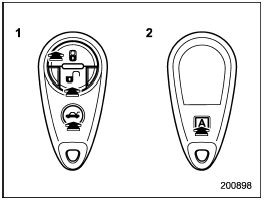
 : Rear gate unlock button
 : Unlock/disarm button
 : Lock/arm button
A: Panic button
1) Front
2) Back
See also:
Refueling in cold weather
To help prevent moisture from forming in
the fuel system and the risk of its freezing,
use of an antifreeze additive in the fuel
tank is recommended during cold weather.
Use only additives that ...
Acc
In this position the electrical accessories (radio, accessory power outlet, etc.)
can be used. ...
Passenger compartment area
1) Lower anchorages for child restraint system (page 1-33)
2) Seatbelt (page 1-12)
3) Center console (page 6-6)
4) Front seat (page 1-2)
5) Rear seat (page 1-7)
1) Top tether anchorages (page ...