


Towing and tie-down hooks/holes
The towing hooks should be used only in an emergency (e.g., to free a stuck vehicle from mud, sand or snow).
CAUTION
● Use only the specified towing hooks and tie-down hooks/holes. Never use suspension parts or other parts of the body for towing or tie-down purposes.
● Never use the tie-down hole closest to the muffler under the vehicle for towing purposes.
● To prevent deformation to the bumper and the towing hook, do not apply excessive lateral load to the towing hooks.
Front towing hook:
1. Take out the towing hook and screwdriver from the on board tool bucket. Take out the jack handle from the trunk (Legacy) or cargo area (Outback).
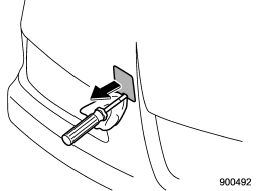
2. Pry off the cover on the front bumper using a screwdriver, and you will find a threaded hole for attaching the towing hook.
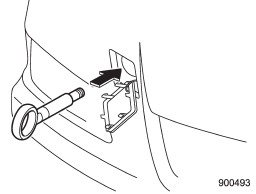
3. Screw the towing hook into the threaded hole until the threads can no longer be seen.
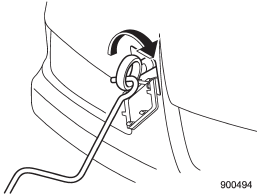
4. Tighten the towing hook securely using the jack handle.
After towing, remove the towing hook from the vehicle and stow it in the tool bucket. Fit the towing hook cover on the bumper.
WARNING
● Do not use the towing hook except when towing your vehicle.
● Be sure to remove the towing hook after towing. Leaving the towing hook mounted on the vehicle could interfere with proper operation of the SRS airbag system in a frontal collision.
Rear towing hook:
1. Take the towing hook out of the tool bucket and take the screwdriver out of the tool bucket. Take the jack handle out of the trunk (Legacy) or cargo area (Outback).
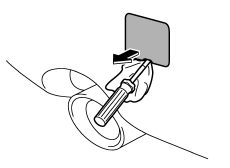
2. Pry off the cover on the rear bumper using a screwdriver, and you will find a threaded hole for attaching the towing hook.
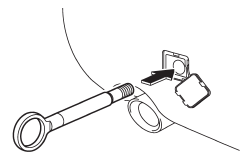
3. Screw the towing hook into the threaded hole until its thread can no longer be seen.
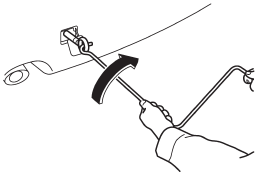
4. Tighten the towing hook securely using the jack handle.
After towing, remove the towing hook from the vehicle and stow it in the tool bucket. Fit the towing hook cover on the bumper.
WARNING
Do not use the towing hook except when towing your vehicle.
Front tie-down hooks:
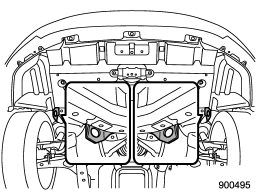
The front tie-down hooks are located between each of the front tires and the front bumper.
Rear tie-down holes:
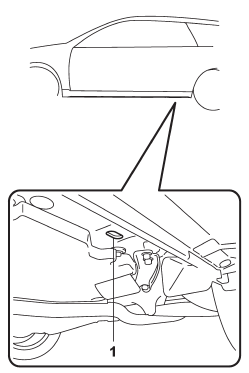
1) Rear tie-down hole
The rear tie-down holes are located near each of the jack-up reinforcements.
WARNING
Use the rear tie-down holes only for downward anchoring. If they are used to anchor the vehicle in any other direction, cables may slip out of the holes, possibly causing a dangerous situation.
See also:
Registering by phone
1. Select the “BY PHONE” menu.
2. Select the “CONFIRM” menu. Then
“TRANSFER” is displayed.
3. Transfer the data from the cell phone.
For details about transferring the data,
refer to the Owner’ ...
Before checking or servicing in the engine compartment
• Always stop the engine and set the parking brake firmly to prevent the vehicle from moving.
• Always let the engine cool down.
Engine parts become very hot when the engine is running and remai ...
Checking the fluid level
The automatic transmission fluid expands largely as its temperature rises; the
fluid level differs according to fluid temperature. Therefore, there are two different
scales for checking the level ...