


Loading your vehicle

• Never allow passengers to ride on a folded rear seatback, in the trunk or in the cargo area. Doing so may result in serious injury.
• Never stack luggage or other cargo higher than the top of the seatback because it could tumble forward and injure passengers in the event of a sudden stop or accident. Keep luggage or cargo low, as close to the floor as possible.
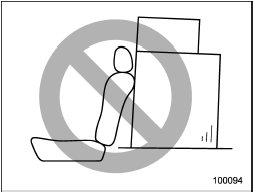
• When you carry something inside the vehicle, secure it whenever you can to prevent it from being thrown around inside the vehicle during sudden stops, sharp turns or in an accident.
• Do not pile heavy loads on the roof. These loads raise the vehicle’s center of gravity and make it more prone to tip over.
• Secure lengthy items properly to prevent them from shooting forward and causing serious injury during a sudden stop.
• Never exceed the maximum load limit. If you do, some parts on your vehicle can break, or it can change the way your vehicle handles. This could result in loss of control and cause personal injury. Also, overloading can shorten the life of your vehicle.
• Do not place anything on the rear shelf behind the rear seatback (for 4-door) or the extended cargo area cover (for 5-door). Such items could tumble forward in the event of a sudden stop or a collision. This could cause serious injury.

Do not carry spray cans, containers with flammable or corrosive liquids or any other dangerous items inside the vehicle.
NOTE
For better fuel economy, do not carry unneeded cargo.
See also:
Internal trunk lid release handle
The internal trunk lid release handle is a device designed to open the trunk
lid from inside the trunk. In the event children or adults become locked inside
the trunk, the handle allows them to op ...
Initialization of power window
If the vehicle’s battery is disconnected due to situations such as battery or
fuse replacement, the following functions are deactivated.
● One-touch auto up/down function
● Anti-entrap ...
Electronic Brake Force Distribution (EBD) system
The EBD system maximizes the effectiveness
of the brakes by allowing the rear
brakes to supply a greater proportion of
the braking force. It functions by adjusting
the distribution of braking ...