


Tire pressures and wear
Maintaining the correct tire pressures helps to maximize the tires’ service lives and is essential for good running performance. Check and, if necessary, adjust the pressure of each tire (including the spare) at least once a month (for example, during a fuel stop) and before any long journey.
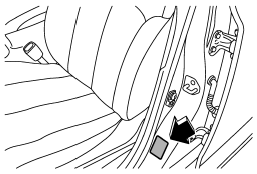
Check the tire pressures when the tires are cold. Use a pressure gauge to adjust the tire pressures to the values shown on the tire placard. The tire placard is located on the door pillar on the driver’s side.
Driving even a short distance warms up the tires and increases the tire pressures. Also, the tire pressures are affected by the outside temperature. It is best to check tire pressure outdoors before driving the vehicle.
When a tire becomes warm, the air inside it expands, causing the tire pressure to increase. Be careful not to mistakenly release air from a warm tire to reduce its pressure.
NOTE
● The air pressure in a tire increases by approximately 4.3 psi (30 kPa, 0.3 kgf/cm2) when the tire becomes warm.
● The tires are considered cold when the vehicle has been parked for at least 3 hours or has been driven less than 1 mile (1.6 km).
WARNING
Do not let air out of warm tires to adjust pressure. Doing so will result in low tire pressure.
Incorrect tire pressures detract from controllability and ride comfort, and they cause the tires to wear abnormally.
● Correct tire pressure (tread worn evenly)
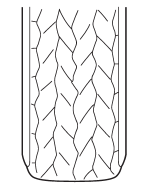
Roadholding is good, and steering is responsive. Rolling resistance is low, so fuel consumption is also lower.
● Abnormally low tire pressure (tread worn at shoulders)
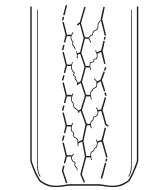
Rolling resistance is high, so fuel consumption is also higher.
Abnormally high tire pressure (tread worn in center)
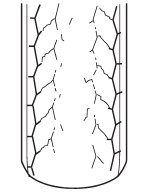
Ride comfort is poor. Also, the tire magnifies the effects of road surface bumps and dips, possibly resulting in vehicle damage.
WARNING
Driving at high speeds with excessively low tire pressures can cause the tires to deform severely and to rapidly become hot. A sharp increase in temperature could cause tread separation, and destruction of the tires. The resulting loss of vehicle control could lead to an accident.
See also:
Nearing Obsolescence?
Just a year or two ago, we pointed out that there wasn't much difference
between the Outback and the Subaru Forester, aside from price. Now that a
larger, redesigned Forester is on the market for ...
Construction
The generic name of each cord
material used in the plies (both
sidewall and tread area) of this tire.
For example, “PLIES: TREAD 2
STEEL + 2 POLYESTER SIDEWALL
2 POLYESTER” ...
Installation of accessories
Always consult your SUBARU dealer
before installing a citizen band radio or
other transmitting device in your vehicle.
Such devices may cause the electronic
control system to malfunction if the ...