


Catalytic converter
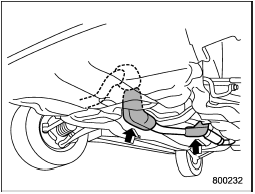
Turbo models
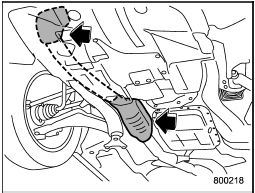
Non-turbo models
The catalytic converter is installed in the exhaust system. It serves as a catalyst to reduce HC, CO and NOx in exhaust gases, thus providing cleaner exhaust.
To avoid damage to the catalytic converter:
• Use only unleaded fuel. Even a small amount of leaded fuel will damage the catalytic converter.
• Never start the engine by pushing or pulling the vehicle.
• Avoid racing the engine.
• Never turn off the ignition switch while the vehicle is moving.
• Keep your engine tuned-up. If you feel the engine running rough (misfiring, backfiring or incomplete combustion), have your vehicle checked and repaired by an authorized SUBARU dealer.
• Do not apply undercoating or rust prevention treatment to the heat shield of catalytic converter and the exhaust system.
• Do not drive with an extremely low fuel level.

• Avoid fire hazards. Do not drive or park the vehicle anywhere near flammable materials (e.g., grass, paper, rags or leaves), because the catalytic converter operates at very high temperatures.
• Keep everyone and flammable materials away from the exhaust pipe while the engine is running.
The exhaust gas is very hot.
See also:
Parking brake lining
1. Drive the vehicle at a speed of approximately 22 mph (35 km/h).
2. With the parking brake release button pushed in, pull the parking brake lever SLOWLY and GENTLY (pulling with a force of approxim ...
CD player operation
NOTE
● Make sure to always insert a disc with the label side up. If a disc is inserted
with the label side down, the player displays “CHECK DISC”. Refer to “When the following
messages are ...
Cleaning the interior
Use a soft, damp cloth to clean the climate control panel, audio equipment, instrument panel, center console, combination meter panel, and switches. (Do not use organic solvents.) ...