


Active head restraint
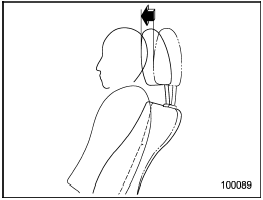
The front seats of your vehicle are equipped with active head restraints. They automatically tilt forward slightly in the event the vehicle is struck from the rear, decreasing the amount of rearward head movement and thus reducing the risk of whiplash. For maximum effectiveness, the head restraint should be adjusted so that the center of the head restraint is closest to the top of the occupant’s ears.

- Each active head restraint is effective only when its height is properly adjusted and driver/passenger sits in the correct position on the seat.
- If your vehicle is involved in a rear-end collision, have an authorized SUBARU dealer inspect the active head restraints.
- The active head restraints may not operate in the event the vehicle experiences only a slight impact in the rear.
- The active head restraints may be damaged if they are pushed hard from behind or subjected to shock. As a result, they may not function if the vehicle suffers a rear impact.
See also:
Hill Holder function
The electronic parking brake system has a Hill Holder function. If the Hill Holder
function is activated, the parking brake will be automatically applied when stopping
on an uphill slope with the ...
To use as full-automatic climate control system
1. Place the temperature control dial in
the position for the preferred temperature.
2. Set the airflow control dial and fan
speed control dial in the “AUTO” position.
The system’s functions wil ...
Windshield wiper blade assembly
1. Raise the wiper arm off the windshield.
1) Open the cover
2) Pull down the wiper blade
2. Remove the wiper blade assembly by opening the cover and pulling it down in
the direction shown in t ...