


Rear center seatbelt on Outback
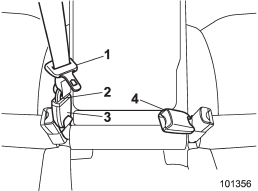
1) Center seatbelt tongue plate
2) Connector (tongue)
3) Connector (buckle)
4) Center seatbelt buckle
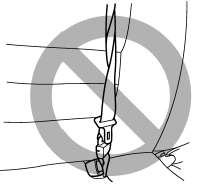
WARNING
Fastening the seatbelt with the webbing twisted can increase the risk or severity of injury in an accident. When fastening the belt after it is pulled out from the retractor, especially when inserting the connector’s tongue plate into the mating buckle (on right-hand side), always check that the webbing is not twisted.
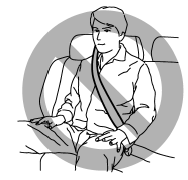
WARNING
Be sure to fasten both tongue plates to the respective buckles. If the seatbelt is used only as a shoulder belt (with the connector’s tongue plate not fastened to the connector’s buckle on the right-hand side), it cannot properly restrain the wearer in position in an accident, possibly resulting in serious injury or death.
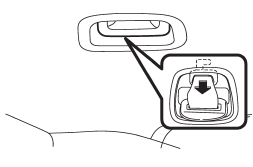
Rear center seatbelt is stowed in the recess of the ceiling.
1. Retrieve the connector (tongue) plate from the slot in the recess by pulling the connector (tongue) plate.
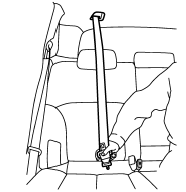
2. Pull out the seatbelt slowly from the retractor.
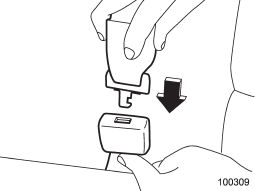
3. After confirming that the webbing is not twisted, insert the connector (tongue) attached at the webbing end into the buckle on the right-hand side until a click is heard. If the belt stops before reaching the buckle, return the belt slightly and pull it out more slowly. If the belt still cannot be unlocked, let the belt retract slightly after giving it a strong pull, then pull it out slowly again.
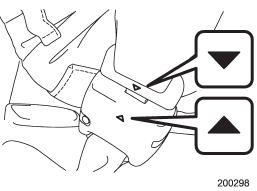
4. After fastening the seatbelt, make sure that the “ ”
”
mark on the connector (tongue) and the “ ”
”
mark on the buckle face outwards.
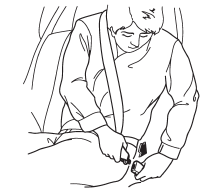
5. Insert the center seatbelt tongue plate into the center seatbelt buckle marked “CENTER” on the left-hand side until it clicks.
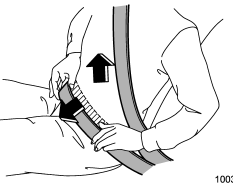
6. To make the lap part tight, pull up on the shoulder belt. And place the lap belt as low as possible on your hips, not on your waist.
See also:
Emergency disarming
If you cannot disarm the system using the transmitter (i.e. the transmitter is
lost, broken or the transmitter battery is too weak), you can disarm the system
without using the transmitter.
The s ...
Winter (snow) tires
Winter tires are best suited for driving on
snow-covered and icy roads. However
winter tires do not perform as well as
summer tires and all season tires on roads
other than snow-covered and ic ...
Storage compartment
CAUTION
● Always keep the storage compartment closed while driving to reduce the risk
of injury in the event of sudden stops or an accident.
● Do not store spray cans, containers with ...