


Child restraint systems
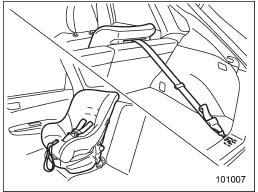
Child restraint systems
Infants and small children should always be placed in an infant or child restraint system in the rear seat while riding in the vehicle. You should use an infant or child restraint system that meets Federal Motor Vehicle Safety Standards or Canada Motor Vehicle Safety Standards, is compatible with your vehicle and is appropriate for the child’s age and size. All child restraint systems are designed to be secured in vehicle seats by lap belts or the lap belt portion of a lap/shoulder belt (except those described in “Installation of child restraint systems by use of lower and tether anchorages (LATCH)”).
Children could be endangered in an accident if their child restraints are not properly secured in the vehicle. When installing the child restraint system, carefully follow the manufacturer’s instructions.
According to accident statistics, children are safer when properly restrained in the rear seating positions than in the front seating positions.
All U.S. states and Canadian provinces require that infants and small children be restrained in an approved child restraint system at all times while the vehicle is moving.
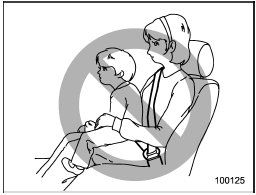

Never let a passenger hold a child on his or her lap or in his or her arms while the vehicle is moving.
The passenger cannot protect the child from injury in a collision, because the child will be caught between the passenger and objects inside the vehicle.
Additionally, holding a child in your lap or arms in the front seat exposes that child to another serious danger.
Since the SRS airbag deploys with considerable speed and force, the child could be injured or even killed.
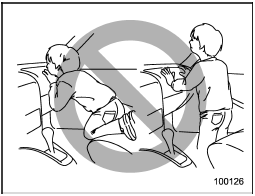
Children should be properly restrained at all times. Never allow a child to stand up, or to kneel on any seat. Unrestrained children will be thrown forward during sudden stop or in an accident and can be injured seriously.
Additionally, children standing up or kneeling on or in front of the front seat are exposed another serious danger. Since the SRS airbag deploys with considerable speed and force, the child could be injured or even killed.
See also:
Cargo tie-down hooks (5-door – if equipped)
The cargo area is equipped with four tiedown hooks so that cargo can be secured with a cargo net or ropes.
When using the tie-down hooks, turn them down out of the storing recesses. When not in use ...
Cleaning the interior
Use a soft, damp cloth to clean the climate control panel, audio equipment, instrument
panel, center console, combination meter panel, and switches. (Do not use organic
solvents.) ...
Installing a booster seat
• Child restraint systems and seatbelts can become hot in a vehicle that has been closed up in sunny weather; they could burn a small child. Check the child restraint system before you place a chi ...