


Calculating total and load capacities varying seating configurations
Calculate the available load capacity as shown in the following examples:
Example 1A
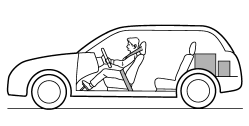
Vehicle capacity weight of the vehicle is 800 lbs (363 kg), which is indicated on the vehicle placard with the statement “The combined weight of occupants and cargo should never exceed 363 kg or 800 lbs”.
For example, if the vehicle has one occupant weighing 154 lbs (70 kg) plus cargo weighing 551 lbs (250 kg).
1. Calculate the total weight.
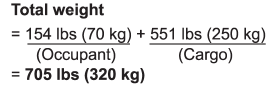
2. Calculate the available load capacity by subtracting the total weight from the vehicle capacity weight of 800 lbs (363 kg).
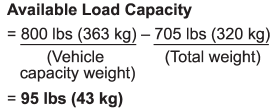
3. The result of step 2 shows that a further 95 lbs (43 kg) of cargo can be carried.
Example 1B
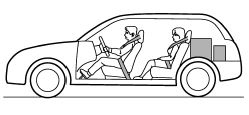
For example, if a person weighing 176 lbs (80 kg) now enters the same vehicle (bringing the number of occupants to two), the calculations are as follows:
1. Calculate the total weight.
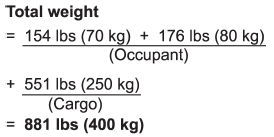
2. Calculate the available load capacity.
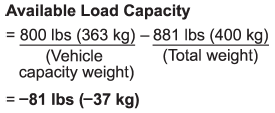
3. The total weight now exceeds the capacity weight by 81 lbs (37 kg), so the cargo weight must be reduced by 81 lbs (37 kg) or more.
Example 2A
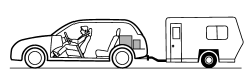
Vehicle capacity weight of the vehicle is 800 lbs (363 kg), which is indicated on the vehicle placard with the statement “The combined weight of occupants and cargo should never exceed 363 kg or 800 lbs”.
For example, the vehicle has one occupant weighing 165 lbs (75 kg) plus cargo weighing 265 lbs (120 kg). In addition, the vehicle is fitted with a trailer hitch weighing 22 lbs (10 kg), to which is attached a trailer weighing 1,764 lbs (800 kg). 10% of the trailer weight is applied to the trailer tongue (i.e. Tongue load = 176 lbs (80 kg)).
1. Calculate the total weight.
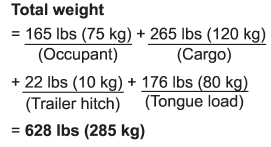
2. Calculate the available load capacity.
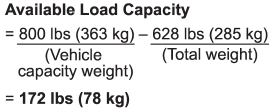
3. The result of step 2 shows that a further 172 lbs (78 kg) of cargo can be carried.
Example 2B
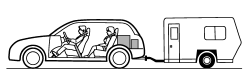
For example, if a person weighing 143 lbs (65 kg) and a child weighing 40 lbs (18 kg) now enter the same vehicle (bringing the number of occupants to three), and a child restraint system weighing 11 lbs (5 kg) is installed in the vehicle for the child to use, the calculations are as follows:
1. Calculate the total weight.
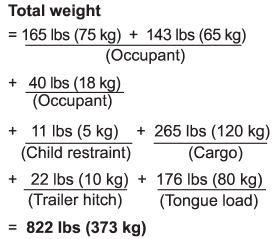
2. Calculate the available load capacity.
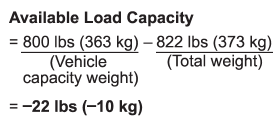
3. The total weight now exceeds the capacity weight by 22 lbs (10 kg), so the cargo weight must be reduced by 22 lbs (10 kg) or more.
See also:
Remote start safety features
For safety and security reasons, the system will fail to start and honk the horn
twice or shut down the engine during remote start operation if any of the following
occur:
● Any of the door ...
Aluminum wheels
Aluminum wheels can be scratched and
damaged easily. Handle them carefully to
maintain their appearance, performance,
and safety.
- When any of the wheels are removed
and replaced for tire ro ...
Display selection
Type A and B audio
Type C audio
If you press the “TEXT” button during playback, the indication will change to the next one in the following sequence.
For CD-DA:
For MP3/WMA/AAC:
For iPod®:
...